


It should come as no surprise that even these simple holemaking tools can give better tool life and improved finish when used with care, and it should be equally well known that understanding how they work best, and how to make the right choices around using them, will give the best results.
Take a few minutes to read this little guide, putting these principles into practice will repay your time and effort the first time you use them and every time thereafter.
Click the titles below for more on each topic.

Annular cutters are generally available in HSS, HSS Co and Carbide Tipped (TCT).
HSS cutters are the softest, so go blunt the quickest and can’t be run hot. HSS Co can be run up to blue hot. TCT teeth tend to fall off when the solder gets hot enough to melt. However, softer cutters are less prone to shattering.

* Coated cutters can be advantageous when drilling materials such as stainless steel. In more common materials, coatings can also improve life but not usually as economically as when used in difficult materials.
**At smaller sizes, up to about 40mm, HSS cutters typically cost less than TCT, but the opposite applies at lager diameters.
Many machines are only single-speed or two-speed, better machines have variable speed control. On pre-set speed machines, your only avenue to optimum cutter life when using larger cutters or drilling hard materials, is to use a carbide tipped cutter and/or copious quantities of lubricant.
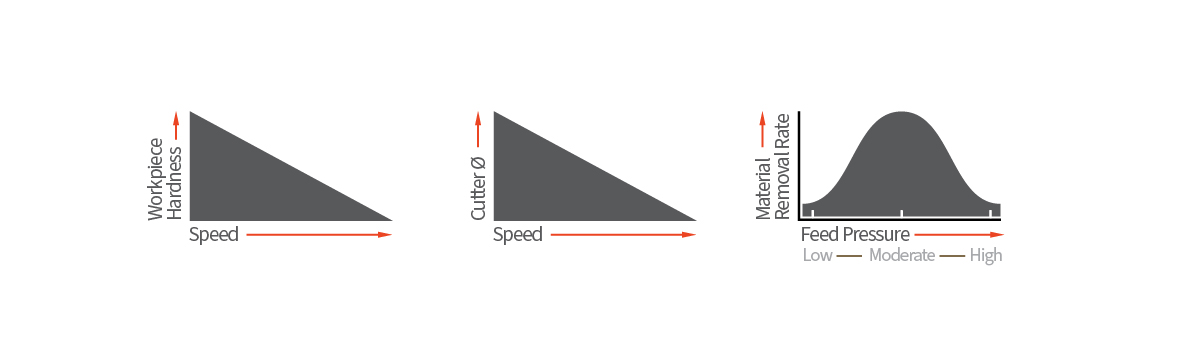
Optimum material removal rates are achieved by using moderate feed pressure. If your cutters need excessive pressure it's a sign they are not sharp. Too low a pressure will increase friction and quickly dull off sharp cutters.
New or freshly sharpened cutters have a supersharp edge which can easily grab and smash the cutter or chip the teeth. For the first few holes, run the cutter in by reducing the usual feed rate – only very light feed pressure is required. This takes the brittle point off the teeth without causing damage to the edge, so your run-in cutter should now last longer.

As a rule of thumb, when the feed rate under gentle to moderate pressure is down to half that of a sharp cutter, you should consider getting your cutter sharpened. It’s false economy to either push the cutter harder, risking breakage, or to allow your productivity to get lower & lower. As a cutter goes blunt, the wear on the teeth increases exponentially – so running that cutter for 500 holes instead of 250 will result in much more than double the grinding work for the saw doctor, and sharpening costs.

However, cutters are not infinitely sharpenable – in the centre core, a few millimeters up from the teeth, there is a line which marks the end of the centre clearance. Sharpening up to or beyond this line means your slugs will get stuck!
Any sort of lubrication is better than none – even water has some slippery qualities about it! For best penetrating lubrication we recommend a high quality, thin neat oil like Altdorf CutNCool, and this is essential to good cutter life if working with hard/tough materials. If you are working vertically or upside down, sometimes a lubricating paste can be more practical. Water soluble oils can also be used and are cheap, but in our opinion don’t provide enough lubricity for most applications and will likely end up costing more in cutters.

If you have a situation where you can’t use any lubrication we would recommend using carbide tipped cutters which are more heat resistant, however even they will still give longer life when well lubricated.
Using annular cutters should be simple and reliable, but your chances of success are greatly improved by some basic understanding of the cutters.
Need more advice on Mag Drilling? See our Hints & Tips online, or get in tough today!