
Before we answer this question, we should point out that these are not the only options, full synthetics are increasingly being used by the sort of operators running multi-centre workshops and large, automated machining facilities, plus there is a growing uptake of MQL systems in some sectors.
However, this is still a common question, especially amongst the kind of operation that makes up the bulk of New Zealand’s workshops. The decision between mineral-based and semi-synthetic coolants can significantly impact your tool life, finish quality, maintenance costs, and even the health of your work environment. With modern machining becoming increasingly demanding, understanding the differences between these two technologies is essential for optimising your operations.
At Wolfmach, we stock both Altdorf Glacier 424 (mineral-based) and Altdorf Arctic 420 (semi-synthetic) precisely because each has its place in different applications. This article will help you understand which formulation is right for your specific needs.
Click the section titles below to see more.

Understanding the Fundamental Differences
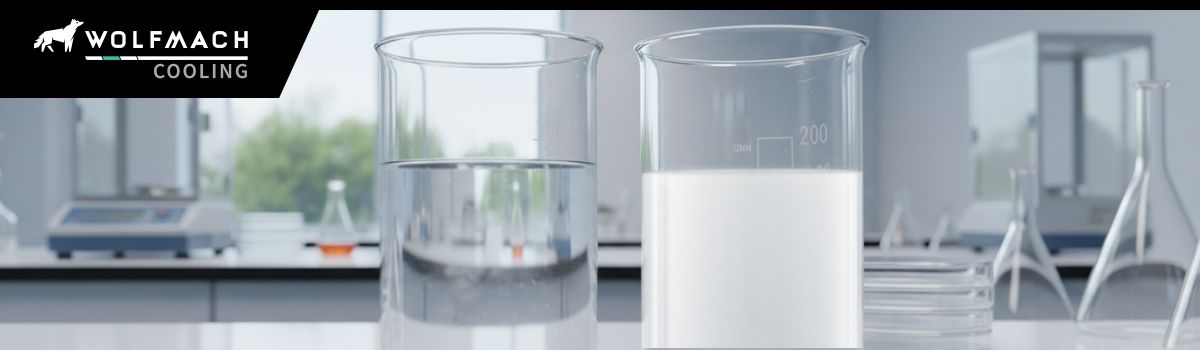
The distinction between mineral and semi-synthetic coolants lies in their base chemistry. Mineral-based coolants, like Glacier 424, are formulated primarily from refined mineral oils with carefully selected chemical additives. When mixed with water, they create a milky emulsion that provides excellent lubrication through the oil content. These have been the workshop standard for decades and remain highly effective for general-purpose machining.
Semi-synthetic coolants, exemplified by Arctic 420, represent a more sophisticated approach. They combine synthetic lubricants with mineral oils, creating what’s known as a micro-emulsion, with oil droplets smaller than the wavelength of visible light. This is how, when diluted, Arctic 420 forms a translucent liquid rather than the opaque milky appearance of mineral coolants. This translucency offers a practical advantage: improved visibility of the machining process, allowing operators to better monitor their work.
The chemical complexity of semi-synthetics also means they typically include more advanced additive packages. Arctic 420, for instance, incorporates specialised extreme pressure (EP) additives that provide enhanced performance in demanding operations, whereas Glacier 424 offers what we describe as ‘mild EP’ – sufficient for general machining but less aggressive than its semi-synthetic counterpart.

Performance: Where Each Technology Excels
Probably less than you think.
You may be surprised to learn how little you need to do to greatly extend the sump life of your cutting fluid. Simple monitoring of its acidity can allow you to treat infections BEFORE you need to empty your sump and regular checks on the dilution ratio will ensure you can keep the concentration optimised for performance and protection at all times.

Comprehensive testing by Altdorf’s technical services has revealed some interesting performance characteristics that challenge common assumptions. Using standardised tapping torque tests for aluminium and Reichert tests for steel, the results show that lubricity performance isn’t simply a case of ‘more advanced equals better.’
For aluminium machining, Glacier 424 demonstrated superior lubrication with a tapping torque result of 72 N·cm, compared to Arctic 420’s 124 N·cm. Lower torque values indicate better lubrication, and this substantial difference confirms what many experienced machinists already know: mineral-based coolants often excel with aluminium and other non-ferrous metals. The high mineral oil content in Glacier 424 creates an effective lubricating film that works particularly well with aluminium’s properties.
However, the picture changes when working with steel. The Reichert test results showed Arctic 420 producing a scar area of 27mm² compared to Glacier 424’s 30mm². While the difference is modest, it indicates Arctic 420’s extreme pressure additives provide an improvement when machining ferrous metals under demanding conditions. For high-speed CNC operations or challenging steel grades, this enhanced EP performance can translate into extended tool life and improved surface finishes.
Both products share excellent anti-bacterial and anti-fungal properties, having proven exceptionally stable in hard water conditions. They’re also both formulated to be chlorine, nitrate, and silicone-free, and are classified as low dermatological irritants – important considerations for workshop health and safety.
Sump Life and Stability Considerations
One area where semi-synthetic coolants often shine is in extended sump life. Arctic 420’s formulation is specifically designed to resist bacterial infection and maintain stability over longer periods. Independent testing on bacterial resistance over storage time shows that Arctic 420 maintains its infection-fighting properties remarkably well, with the concentrate remaining effective even after months of storage.

The semi-synthetic chemistry creates a more stable emulsion that’s less prone to splitting or breaking down. This translates to reduced maintenance, fewer complete sump changes, and lower long-term fluid costs despite the higher initial purchase price. For busy workshops where coolant maintenance can get neglected, or facilities running extended production schedules, this enhanced stability offers tangible benefits.
That said, Glacier 424 shouldn’t be dismissed as inferior in this regard. With proper maintenance – regular concentration checks, pH monitoring, and good housekeeping practices like removing tramp oil and metal fines – mineral coolants can also achieve respectable sump life. The key difference is that semi-synthetics are generally more forgiving of less-than-perfect maintenance regimes.
Cost Analysis: Initial Price vs Long-Term Value

Cost is inevitably a major consideration, and here the comparison becomes more nuanced than simply looking at the price per litre of concentrate. Glacier 424 is positioned as an economical, cost-efficient solution for general-purpose machining. Its lower purchase price makes it attractive for workshops with tight budgets or those processing large volumes of less demanding work.
Arctic 420 commands a premium price, reflecting its more sophisticated formulation and the enhanced performance it delivers. However, the total cost of ownership calculation should factor in several additional considerations beyond the initial purchase price.
Extended sump life means less frequent complete changes, reducing both fluid costs and the labour involved in cleaning and refilling sumps. Longer tool life from better EP performance can offset higher coolant costs, particularly on expensive cutting tools or when machining difficult materials. Reduced maintenance requirements – fewer additive top-ups, less frequent pH adjustments – save technician time. For many operations, when these factors are properly accounted for, the cost gap between mineral and semi-synthetic coolants narrows considerably.
Making Your Decision: Application Recommendations

Choose Glacier 424 mineral coolant when:
Your work is predominantly aluminium or other non-ferrous metals. The superior aluminium lubrication of mineral coolants makes this a clear choice. You’re running general-purpose machining operations that don’t push the boundaries of cutting parameters. You have good coolant maintenance practices in place and can commit to regular monitoring and upkeep. Budget constraints are significant, and you need to keep consumable costs down. You’re working with a range of older machinery where the milky emulsion appearance is preferred or expected.
Choose Arctic 420 semi-synthetic coolant when:
You’re running demanding CNC operations or high-speed machining where tool life is critical. Working primarily with steel or challenging ferrous alloys where EP performance matters. Extended sump life and reduced maintenance frequency offer significant operational benefits. The improved visibility from translucent coolant helps operators monitor cutting operations more effectively. You want the additional insurance of a more stable, forgiving coolant formulation. Your operations justify the investment in premium consumables for the performance gains they deliver.
Conclusion
The mineral versus semi-synthetic choice isn’t about one technology being universally superior to the other. Both Glacier 424 and Arctic 420 are proven, reliable coolants that excel in their intended applications. The right choice depends on your specific machining operations, materials, maintenance capabilities, and budget constraints.
For many workshops, the answer might even be to stock both. Use Glacier 424 as your workhorse for general machining and aluminium work, keeping costs down on high-volume, less demanding operations. Reserve Arctic 420 for your precision CNC machines, difficult materials, or operations where tool life and finish quality are paramount.
What matters most is understanding what each technology offers and matching it to your needs. At Wolfmach, we’re committed to helping you make informed decisions about your cutting fluids. We encourage you to consider not just the purchase price, but the total cost of ownership and the performance benefits that can transform your machining efficiency.
If you’re ready to take your lubrication and cooling seriously, we’d be pleased to discuss your specific requirements and help you identify the optimal coolant solution for your operations. After all, as we noted in our introduction, cutting fluids are far too important to your tool life, finish quality, and workplace environment to simply take for granted.