

Selecting the right metal cutting bandsaw is one of the most important decisions a workshop or production facility will make. Get it right and you gain efficiency, accuracy and long-term value. Get it wrong and you're left with a machine that either holds you back or costs more to run than the job justifies.
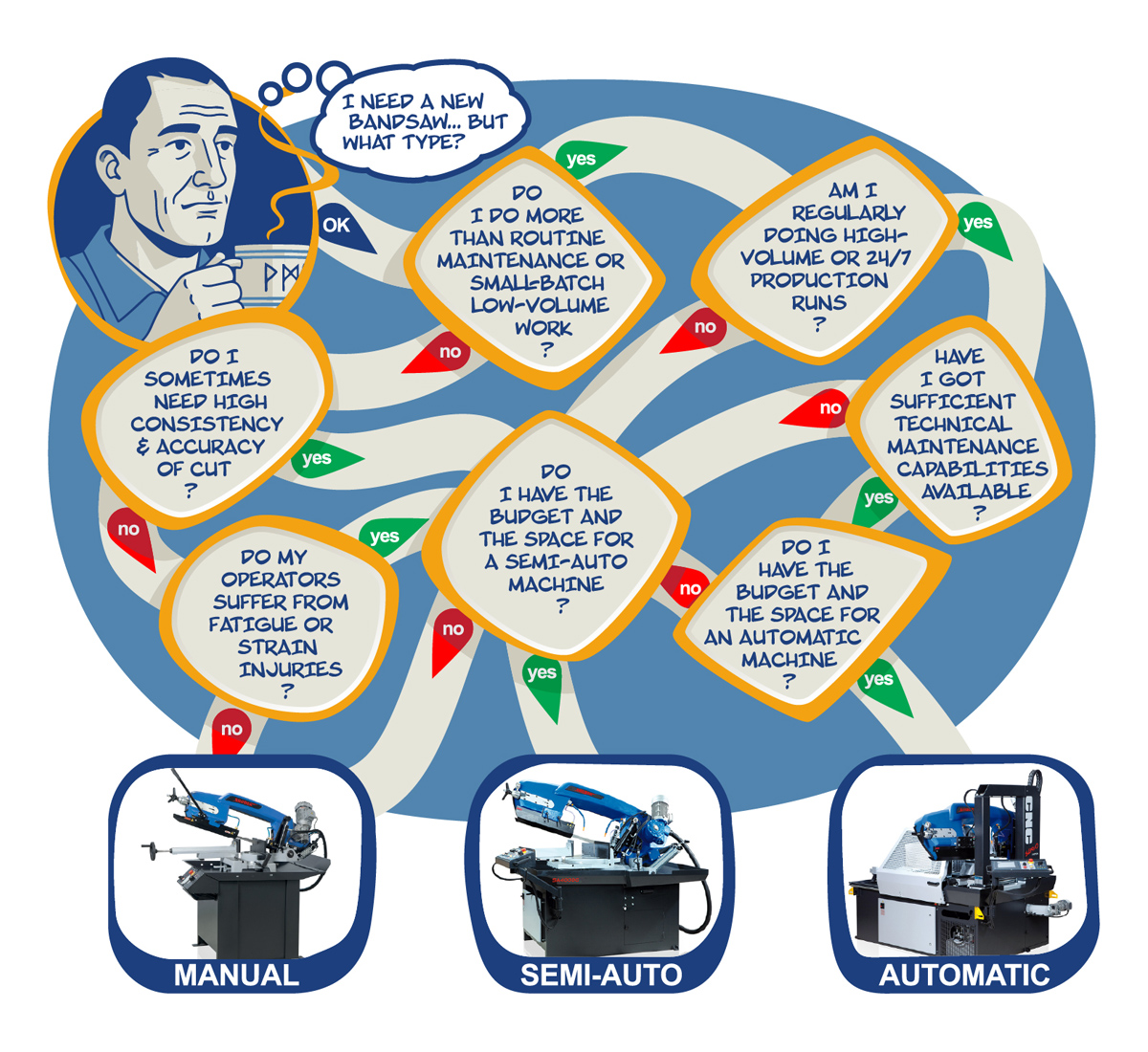
This can make it seem a daunting, difficult decision, fraught with potential pitfalls and the intimidating prospect of a lot of money spent on a machine that doesn’t fit the bill. In reality, provided you've already put a bit of thought into the general necessity for a bandsaw and what kind of capacity or features you'll need, it’s a lot simpler than you might think. (If you're not quite at this stage, we suggest you look at our related article HERE)
Here's a straightforward breakdown of the three main categories — manual, semi-automatic and fully automatic — to help you match the machine to the work.
Click on the options below to see more about each category.


Manual Bandsaws
Manual bandsaws require the operator to control the downfeed pressure by hand and to raise the bow after each cut. They are the most affordable entry point into metal cutting and are well suited to workshops where cuts are infrequent or highly varied in material and size and are frequently used as secondary saws in larger firms for doing the odd quick/smaller jobs that would otherwise interrupt production runs on larger machines.
Pros
- Lower purchase price makes them accessible for small businesses and start-ups.
- Simple mechanics mean fewer things to go wrong and lower maintenance costs.
- Compact footprint suits tight workshop spaces.
Cons
- Downfeed pressure may be inconsistent between operators, affecting blade life and cut quality.
- Not practical for high-volume or repetitive cutting work.
Best Suited To:
- Small engineering workshops and general fabricators.
- Panel beaters and automotive repair shops.
- Rural and agricultural repair operations.
- Trade schools and training facilities.
Semi-Automatic Bandsaws
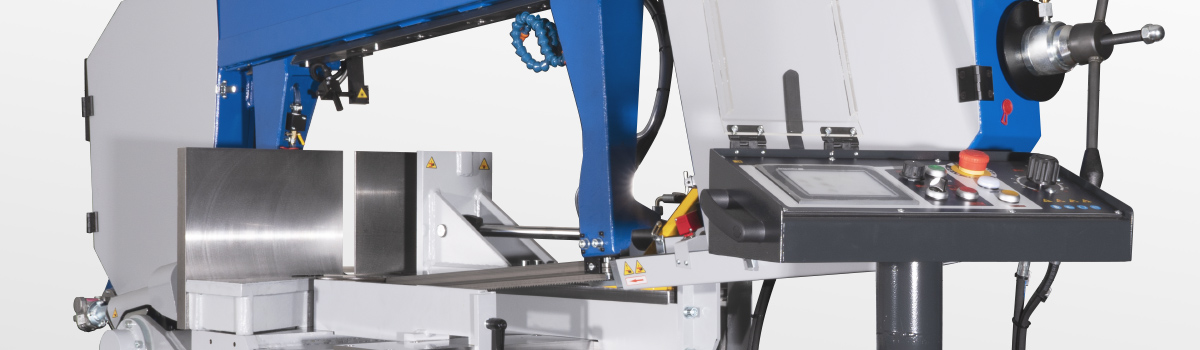
Semi-automatic bandsaws take care of the cutting cycle — the bow descends under hydraulic control and lifts automatically at the end of the cut — but still require the operator to load material and set the vice for each piece. This is the most popular category for job shops and medium-volume production environments.
Pros
-
Controlled hydraulic downfeed delivers consistent cuts and extends blade life.
-
Operator is free to carry out other tasks while the machine is cutting.
-
Good balance between cost and capability for most workshop environments.
-
Wide range of models available across different capacities and price points.
Cons
-
Still requires manual loading and clamping between cuts.
-
Not well suited to very high-volume repetitive production runs.
-
Some operator training required to set feeds and speeds correctly.
Best Suited To:
-
Steel service centres and metal distributors.
-
General engineering and fabrication workshops.
-
Maintenance and repair operations (MRO) in manufacturing plants.
-
Structural steel fabricators.
Fully Automatic Bandsaws
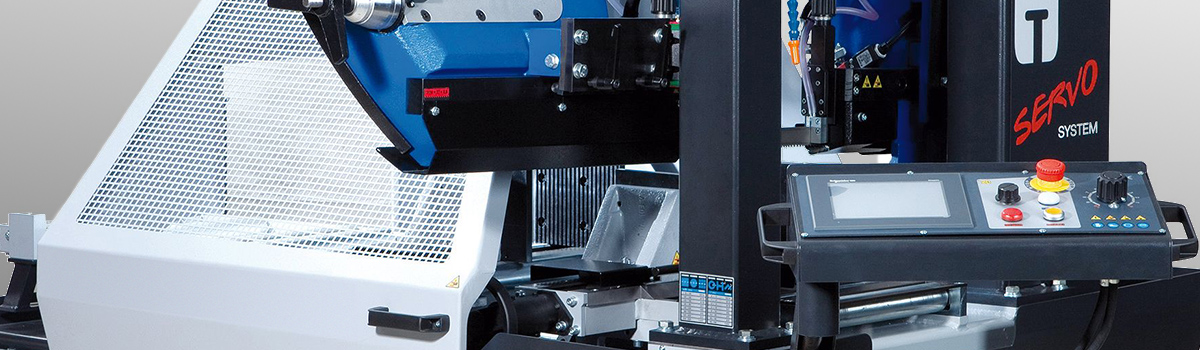
Fully automatic bandsaws automate the entire cutting cycle, including material feeding, clamping, cutting and, in many cases, part ejection. The operator loads bar stock, programs the required lengths and quantities, and the machine runs unattended. These are production-grade machines designed for high throughput.
Pros
-
Unattended operation frees operators for other tasks and enables lights-out running.
-
High consistency and repeatability across large volumes of parts.
-
Integrated feed systems reduce material handling time significantly.
-
Advanced models include optimisable multi-length cut patterns, part counters and material remnant detection..
Cons
- Significantly higher capital investment compared to manual or semi-automatic machines.
- Larger footprint and more complex installation requirements.
- Best value is realised only when running consistent, high-volume work — less versatile for one-off jobs.
- Higher maintenance complexity and greater reliance on technical support.
Best Suited To:
-
High-volume bar stock processors and steel stockholders.
-
Precision component manufacturers and turned parts suppliers.
-
Aerospace, automotive and defence supply chains.
-
Large-scale production workshops running multiple shifts.
CONCLUSION - MAKING THE RIGHT CALL
The right bandsaw is the one that matches your production volume, labour availability and budget, not simply the most advanced machine on the market.
For workshops cutting a handful of pieces a day, a manual or semi-automatic machine will likely deliver better return on investment. For operations where the saw runs continuously and labour costs are a primary concern, a fully automatic machine pays for itself quickly.
If you're unsure which category fits your needs, talk to our team of highly experienced experts, we've helped businesses of all sizes and types get the saw that best fits their needs, budget and future plans.